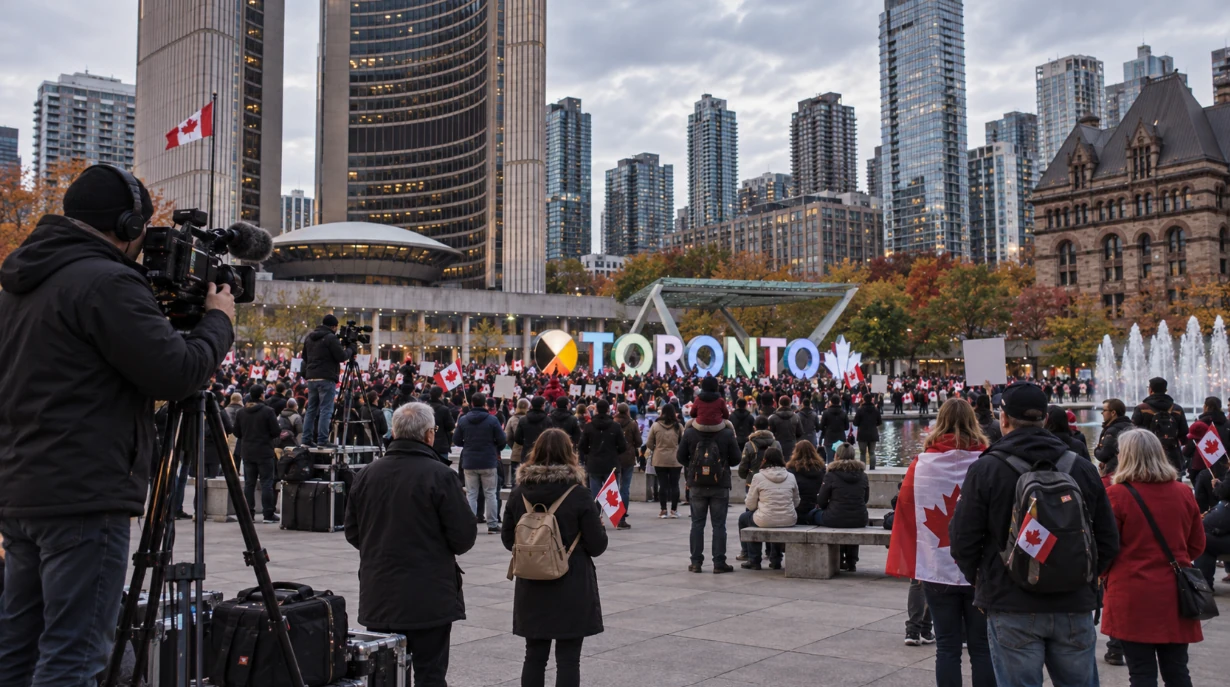
A public gathering gives a city a moment to look at itself. People pause in the same place, hear a shared question and encounter perspectives beyond their usual circle. Some arrive with a clear purpose. Others come to listen, accompany someone or understand what is happening. That range of reasons is part of the story.
For this issue, we follow the connection between a visible gathering and the community life around it. The subject includes social movements, residents’ meetings, cultural occasions and practical neighbourhood work. The supplied illustrations set the scene in Toronto; the article is an explainer, rather than a report from a named event.
Begin with the purpose.
A social movement brings people into continuing action around a shared concern. A gathering is one possible expression of that work. It might create space to speak, mark an occasion, exchange experience or introduce a question to a wider audience. A large crowd and a lasting organisation are different kinds of information.
Look for the purpose in the organiser’s own notice. Is the invitation to a discussion, a celebration, a march, a workshop or a public consultation? What will actually happen when people arrive? The answer helps a newcomer understand whether they can observe, contribute to a conversation or take on a practical task.
| Setting | A useful question | Where to begin |
|---|---|---|
| Public gathering | Who is convening it, and for what purpose? | The original event notice |
| Neighbourhood initiative | What local concern connects the participants? | Community resources |
| City consultation | Which project is seeking input? | Consultation listings |
| Committee discussion | Which agenda item is being considered? | Participation guidance |
A shared place gives the conversation a setting.
Nathan Phillips Square sits outside Toronto City Hall and hosts community and City-led events. The City provides an overview and an events schedule. Official square information
A recognisable public place can make an issue easier to notice. It also holds many conversations at once. People in the same frame may be participants, passers-by, workers or observers. A flag, a camera or a familiar building does not identify every person’s view. The purpose of an event still needs a reliable source.
Think of the square as a meeting point in a larger civic landscape. The question raised there may continue on another day, in another part of the city, among a much smaller group. The size of the setting should not decide which conversation deserves attention.
Follow the idea back to the neighbourhood.
Community activity can begin with an ordinary observation: a shared space could be more welcoming, a local programme is difficult to reach, or residents would like a chance to meet. Describing the concern clearly gives other people something concrete to respond to. It also leaves room for experiences that differ from the first account.
Consider an illustrative example, not a reported Toronto event. Several neighbours want to make better use of a nearby park. One suggests a clean-up; another asks about seating and access; a third offers to find the right contact. A short conversation becomes more useful when those ideas are written down separately, with a possible next step for each.
Toronto’s Community Initiatives directory is a starting point for resident-led activity and development support. Together in Parks includes ways to explore community activities such as clean-ups, arts and stewardship, subject to the programme’s requirements and available support. Community Initiatives Together in Parks
Make room for a first visit.
A useful invitation explains the topic in ordinary language. It gives a current date and meeting place, names the organiser and says what kind of participation is expected. Readers should be able to find practical details about access, registration and who can answer a question. These are things to check on the original notice before leaving home.
When you arrive, listening can be a complete first step. Notice how people introduce the issue, how questions are taken and how different experiences enter the discussion. You can ask for a source or clarification without speaking for anyone else. Decide for yourself whether you want to return, read more or help with a particular activity.
For gatherings at the square, the City’s schedule can lead you to event information and organisers. It is a reference for listed events, rather than a complete account of every use of the space. Check the square’s event schedule
Give the conversation a next step.
Public visibility and a formal decision have their own paths. An independent community meeting can gather experiences or develop a question. A City consultation asks for input on a defined project. A committee meeting considers agenda items. Knowing which process you are looking at makes the follow-up more precise.
Toronto’s engagement platform publishes consultation opportunities and project updates. For matters on a Council or committee agenda, the City explains written comments and requests to speak at committees or boards. Full Council generally does not hear public presenters; the current instructions explain the exceptions and the public-record implications. Find a consultation Read the meeting guidance
You might leave a gathering with one link to read and one question to bring back. A group might share a short account of what was discussed, identify unresolved points and give a date for its next update. These are suggestions for clear follow-through, rather than a promise that any activity will produce a particular outcome.
Keep the public conversation open.
Community life leaves room for different kinds of involvement. Some people enjoy a busy public event. Others contribute through a smaller conversation, a written response or practical work. Time, access and personal circumstances shape what feels manageable.
Start with a subject you want to understand. Check the invitation, read a primary source and choose a step that suits you. Our seven-point gathering notebook helps you prepare; the neighbourhood guide looks more closely at how an everyday concern can become a shared discussion.
Explore the original resources.
Primary sources reviewed on 11 October 2026. Consult the current official listing for dates, availability and participation instructions.